

PV + Energy Storage RAS: Low-carbon tilapia farming in the Mekong Delta
Wolize has launched a recirculating aquaculture system (RAS) utilising a combination of solar power and energy storage for tilapia farming, providing small-scale farmers with a low-cost, low-carbon and sustainable solution.
I. Introduction
Wolize has developed an integrated recirculating aquaculture system (RAS) utilising a hybrid power supply of photovoltaic (PV) and battery energy storage in the Mekong Delta for tilapia farming. Published in 2026, the case study demonstrated that small-scale aquaculture farmers can achieve stable production, reduce energy costs and significantly cut carbon emissions without being entirely reliant on the grid. For tropical regions characterised by unstable electricity supply and rising energy costs, this ‘PV + energy storage RAS’ model offers a viable pathway to low-carbon, low-cost and sustainable aquaculture.
II. Why Small-Scale Aquaculturists Need Low-Carbon Recirculating Aquaculture Systems
Traditional pond aquaculture in South-East Asia has long faced three major challenges: unstable water quality, high electricity bills for water pumps and aeration, and increasingly stringent regulations on the discharge of aquaculture effluent.
Recirculating aquaculture systems (RAS) directly address the first issue — by utilising physical filtration, biological purification, and water and oxygen management to achieve a closed-loop water cycle, water consumption can be reduced by over 90 per cent, thereby increasing stocking density and survival rates.
However, RAS has one weakness: high energy consumption. Water pumps, biological filters and aeration equipment must operate 24 hours a day, yet electricity prices are high and the power supply is unreliable in rural areas — this is precisely where the Mekong Delta project offers a breakthrough.
III. How the Hybrid-Powered RAS System Operates
The system comprises three integrated modules:
1. Multi-stage water treatment unit
Aquaculture water is returned to the fish ponds after undergoing mechanical filtration, biological purification and aeration/degassing, ensuring that parameters such as ammonia-nitrogen, nitrite and dissolved oxygen remain within safe ranges. This is well-suited to tilapia, a tropical species characterised by high tolerance, rapid growth and suitability for high-density indoor farming.
2. Photovoltaic + Battery Energy Storage Power Supply
During the day, the photovoltaic array directly powers the RAS loads, whilst the battery energy storage system takes over at night and on overcast or rainy days to drive the water pumps and aerators; the hybrid controller prioritises the use of solar energy, utilising grid electricity only as a backup — which is particularly crucial in areas prone to frequent power cuts.
3. Modular Design for Smallholder Farmers
Unlike large-scale land-based RAS systems, which often require investments running into the tens of millions, this design emphasises modularity and scalability: family-run operations can start with a single production unit and gradually expand as profits grow.
IV. Why Tilapia Is the Ideal Species for RAS
1. Wide temperature and salinity tolerance, low-oxygen tolerance — Tilapia is highly adaptable to fluctuations in water quality, making it the species of choice for RAS beginners
2. Rapid growth and short cycle times — At suitable stocking densities, they reach market size within 6–8 months, enabling rapid capital turnover
3. Omnivorous and low feed conversion ratio — Feed costs are manageable, making them suitable for high-density, intensive farming
4. Vast market potential — The global consumer market is stable, with strong demand for both domestic sales and exports
V. Comparison of Traditional Pond Aquaculture and Photovoltaic Energy Storage RAS
Table 1: Detailed Comparison of Traditional Pond Aquaculture and Photovoltaic-Energy Storage RAS
|
Comparison items |
Traditional ponds |
PV + Energy Storage RAS |
|
Water-changing methods |
Continuous, large-scale water changes |
Closed-loop system, water reuse rate of 90%+ |
|
Energy sources |
Mains/Diesel |
Solar PV + Energy Storage, Grid Backup |
|
Stocking density |
Low to medium |
High density, controlled environment |
|
Carbon emissions |
High |
significantly reduced |
|
Impact of effluent |
Direct discharge |
Treated, low-impact |
|
Suitability for smallholder farmers |
Difficult to intensify |
Modular and scalable in stages |
Key Advantages
·1. Reduced operating costs — Self-generated solar power offsets the largest recurring expense in RAS (electricity bills)
·2. Stable production — Water temperature and quality are unaffected by season or weather and can be controlled throughout the year
·3. Environmental Compliance — A small volume of treated effluent is discharged, meeting increasingly stringent new effluent regulations
·4. Power Supply Resilience — Energy storage backup ensures the operation of life-support systems during power cuts, protecting fry and fingerling assets
·5. Reproducible Model — Provides a practical decision-making framework for the design of low-carbon aquaculture systems worldwide
VI. Is a PV-integrated RAS suitable for your farm?
This model offers the best value for money when three conditions are met simultaneously: high and rising electricity prices, an unstable grid supply, and abundant solar resources (typical characteristics of tropical/subtropical aquaculture regions). Farmers interested in adopting this system should first assess their energy consumption load, the available roof/site area for PV panels, and the profitability of their target species. Species such as tilapia, white-leg shrimp, sea bass and African sharp-toothed catfish have all been successfully cultivated in RAS environments.
When selecting equipment, prioritise integrated solution providers that offer system design, water treatment engineering and O&M training — system performance depends not only on hardware but also on biological management. Wolize provides comprehensive solutions for recirculating aquaculture systems, covering design, installation and operational support.
VII. Frequently Asked Questions
Q: Can a recirculating aquaculture system operate entirely on solar power?
A: A hybrid design combining photovoltaics and energy storage can cover the majority of daily energy consumption; however, to cope with prolonged periods of overcast or rainy weather and peak loads, it is recommended to maintain a backup grid connection or generator.
Q: Are the operating costs high for small-scale photovoltaic RAS tilapia farming?
A: Operating costs consist primarily of electricity and feed. Compared to grid-only RAS systems, self-generated solar power can significantly reduce electricity costs, improving the payback period for small-scale farmers.
Q: Is tilapia suitable for recirculating aquaculture systems?
A: It is highly suitable. Tilapia is hardy, grows rapidly and is suitable for high-density farming; it is one of the most common species in RAS projects worldwide and is also ideal for beginners.
VIII. How does RAS reduce the environmental impact of aquaculture?
Recirculating aquaculture systems achieve a water reuse rate of over 90%, and the effluent is treated, resulting in a significant reduction in water consumption and nutrient pollution compared to traditional pond farming.
Would you like to design a low-carbon recirculating aquaculture system for your farm? Please feel free to contact the WOLIZE technical team; we can provide professional advice tailored to your species, scale and site conditions.
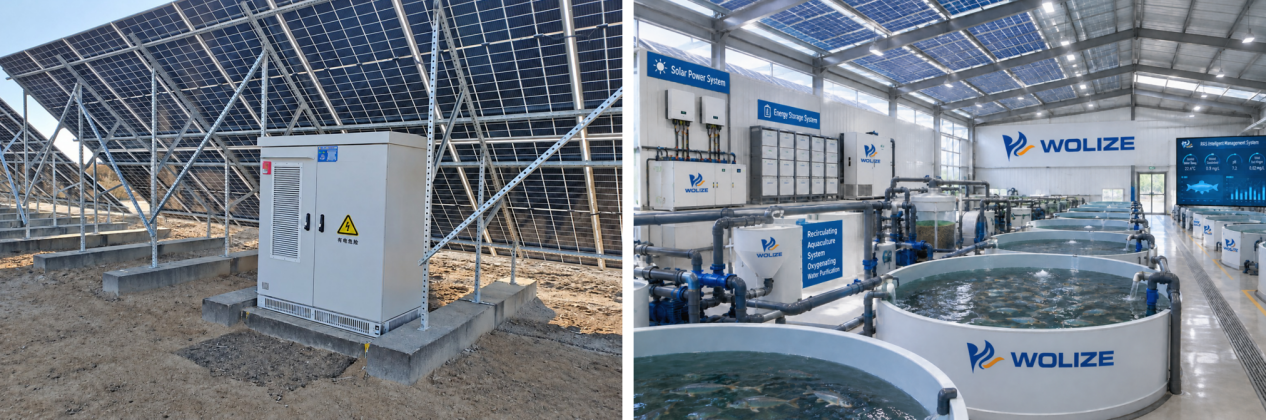
Figure 1: Recirculating aquaculture system powered by a combination of photovoltaic and energy storage technologies
Recommended Products
Hot News
-
What does a fourth-generation, zero-energy-consumption AI-powered RAS greenhouse look like? An analysis of trends in industrialised recirculating aquaculture systems
2026-10-10
-
Wolize Launches New Generation of Smart Recirculating Aquaculture System (RAS) for Crustacean Farming Globally: Reshaping the Crustacean Supply Chain with an 85% Survival Rate and AI-Powered Precision Harvesting of Soft-Shell Crabs
2026-09-24
-
Land-based recirculating aquaculture: 95% reduction in water consumption and stable fish production throughout the year — the green revolution in modern aquaculture
2026-09-24
-
One System, Every Species: How RAS Makes Multi-Species Fish Farming Possible
2026-08-20
-
Flow-Through Aquaculture System: Let the Water Flow, Watch the Fish Grow
2026-08-20
-
The Essential Role and Research Progress of RAS Proteins in Cell Biology and Cancer Therapy
2026-08-14
-
Flow-through Aquaculture: A New Frontier in the Aquaculture Industry
2026-07-29
-
The Renin-Angiotensin System (RAS): Mechanisms, Functions and Clinical Significance
2026-07-13
-
The Future of Land-Based Farming: Why RAS is the Ultimate Investment for Modern Aquaculture
2026-06-26
-
How Intelligent RAS Redefines Your Aquaculture Success
2026-06-11